As the core equipment of internal lightning protection, Surge Protective Device (SPD) plays a decisive role in protecting electronic equipment from induced lightning damage. This article focuses on SPD’s working principle, key selection parameters and application guidelines, helping you scientifically select and use SPD.
1. Working Principle of SPD
SPD is equivalent to a “voltage safety valve” in the line, with the core working principle of “detection-conduction-discharge-recovery”. When an overvoltage exceeding the safe threshold appears in the line, the nonlinear components (such as varistors, discharge tubes) inside the SPD quickly conduct, shunting the excess voltage and current to the ground through the grounding loop. After the overvoltage disappears, the components quickly return to a high-resistance state without affecting the normal power supply of the line.
2. Classification of SPD by Application Scenarios
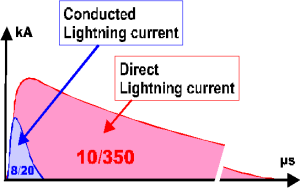
• Power SPD: Suitable for 220V/380V and other power lines. Divided into Class I (protecting against direct lightning induction, impulse current ≥10kA), Class II (protecting against induced lightning, impulse current ≥5kA) and Class III (fine protection for equipment front ends), which need to be used in multi-level cooperation.
• Signal SPD: For network (RJ45), monitoring (BNC), communication (RS485) and other signal lines. It is necessary to match the line transmission frequency and interface type to avoid affecting signal transmission.
• RF SPD: Used for radio frequency lines such as antennas and satellite receiving equipment. The core requirement is low insertion loss to ensure communication quality.
3. Key Selection Parameters of SPD
The core of SPD selection is to match the protection scenario and equipment requirements. The key parameters directly determine the protection effect and service life:
• Maximum Continuous Operating Voltage (Uc): The maximum AC/DC voltage that SPD can withstand for a long time. Selection basis: Uc must be greater than the maximum working voltage of the line (e.g., 275V for 220V civil lines, 420V for 380V industrial lines).
• Nominal Discharge Current (In): The peak value of 8/20μs lightning current waveform that SPD can withstand multiple times. Selection basis: Match the protection zone and lightning activity intensity (10-20kA for Class I SPD, 5-10kA for Class II SPD, 2.5-5kA for Class III SPD).
• Maximum Discharge Current (Imax): The maximum single 8/20μs lightning current peak that SPD can withstand, reflecting the extreme current discharge capacity. Selection basis: Imax ≥1.5-2 times In, matching the regional lightning level (≥40kA for high lightning areas).
• Protective Voltage (Ucpv): The maximum voltage at both ends of SPD when passing In, directly determining the protection effect. Selection basis: Ucpv must be less than the impulse voltage withstand limit of the protected equipment (≤1.2kV for precision electronic equipment).
• Response Time (tA): The time from detecting overvoltage to full conduction. Selection basis: ≤25ns for power SPD, ≤1ns for signal SPD (faster response for high-frequency signals).
• Protection Level (IP): Reflects the protection capacity against solid foreign objects and liquid intrusion. Selection basis: IP65+ for outdoor installation, IP20 for indoor dry environment.
• Interface and Frequency (for signal/RF SPD): Match the line interface type and working frequency range to ensure no impact on signal transmission (insertion loss ≤0.5dB for RF SPD).
4. SPD Multi-Level Protection Application Principles
SPD installation must follow the “multi-level protection” principle according to the LPZ division:
• Install Class I power SPD at the junction of LPZ 0 and LPZ 1 (e.g., building main distribution box) for primary discharge;
• Install Class II power SPD at the junction of LPZ 1 and LPZ 2 (e.g., floor distribution box) to further attenuate overvoltage;
• Install Class III power SPD at the front end of equipment (e.g., server power port) for fine protection;
• Install corresponding signal SPD at the interface of signal lines entering and exiting the protection zone to ensure full-link protection.
5. Common Misunderstandings About SPD
• Myth 1: “Installing a lightning rod is enough” — Lightning rods only protect against direct lightning strikes; SPD and equipotential bonding are required for induced lightning protection.
• Myth 2: “The more SPDs installed, the better” — Scientific configuration according to protection levels is needed; excessive installation causes mutual interference and malfunctions.
• Myth 3: “Indoor equipment does not need lightning protection” — Induced lightning mainly endangers indoor electronic equipment; internal lightning protection measures are essential.
6. Development Trend of SPD
Current lightning protection systems are moving towards intelligence and integration. Intelligent SPD (with status monitoring, fault alarm and remote communication functions) has become an industry trend. By real-time grasping the working status of SPD, the operation and maintenance efficiency of the lightning protection system can be greatly improved, which is one of the core development directions of future lightning protection technology.